EARLY-N

Insights

Blog

Latest updates, guidance, and platform stories from EARLY-N.

Nov 13, 2026

Why Ethical Investing Matters More Than Ever

By Norman Muchanyuka, Founder & CEO of Early-N Digital Ethical Investments Ltd For decades, the financial world asked only one question: What return can I generate? But the investment landscape is changing.Today, investors are asking a second, equally important question: What positive impact can my capital create? People no longer want to choose between making a profit and making a difference. They want their money to contribute positively to society, support economic development, and encourage responsible environmental practices.This shift has led to the rapid growth of ethical investing. What Is Ethical Investing? At its core, ethical investing is the practice of choosing investments based on both financial performance and broader social, environmental, and governance (ESG) considerations. It means directing capital toward things that actually matter, such as: Affordable housing developments Renewable energy projects Sustainable transport and mobility Community development activities Responsible businesses with strong governance Unlike traditional investing, ethical investing recognizes that capital can be a powerful tool to catalyse long-term, positive change. The Growing Demand for Responsible Capital Around the world, investors are actively seeking ways to align their portfolios with sustainable development goals. We are seeing massive attention shift toward specific sectors, including: Green infrastructure Electric mobility Clean energy Social and affordable housing Digital inclusion Sustainable agriculture This trend is creating incredible opportunities. But it also creates a problem: how do you find these opportunities, and how do you know they are legitimate? The Role of Early-N Early-N Digital was built to solve this exact problem. We are an ethical investment platform designed to connect forward-thinking investors with responsible projects and visionary founders.We don't just talk about impact we structure it. Here is how we bring ethical investing to life: 1 . 14 Strictly Vetted Sectors We focus on 14 ethical sector categories aligned with ESG classifications. From Clean Energy and Climate Tech to EdTech and Eco Empowerment, we ensure your capital flows exactly where you want it to. 2 . Quality Over Quantity We pre-screen every single founder. Our vetting process verifies their ethical credentials and business model before they appear on the platform. We would rather have an empty sector than list a business that doesn't meet our standards. 3 . Biometric Trust Because we connect investors across the UK, Europe, Africa, and the BRICS nations, security is our highest priority. We use biometric verification to protect your identity, your data, and your access. Identity is dignity. 4 . Admin-Facilitated Completion We don't just introduce you to a founder and walk away. Once interest is established, our admin team steps in to facilitate formal agreements, schedule meetings, and handle commission tracking. We ensure every deal is legally sound and professional. Looking Ahead Ethical investing is no longer a niche activity. It is becoming the mainstream investment philosophy for High Net Worth Individuals, Angel Investors, and institutions who want long-term, sustainable value. Investors are asking not only: What return can I generate? but also: What positive impact can my investment create? At Early-N, we are building the digital infrastructure to answer both questions. We are connecting capital with conscience, and empowering ethical growth across the globe.The future belongs to those with the courage to deploy capital responsibly. Ready to invest where it matters? Join the movement today at early-n.com .

Read blog

Nov 7, 2026

The Ethical Capital Report,Why Early-N Exists

Let's be honest investing has always felt like a club. You need the right connections, the right know-how, or a serious amount of money to even get through the door. But here's the thing: some of the most exciting opportunities out there happen when fresh ideas, technology, and doing good all come together. That's exactly why Early-N exists.This didn't start in some fancy boardroom with investors throwing money at it. It started with grit, a lot of learning, and a firm belief that finance should work for people not just for profit.Like a lot of founders, I've had my share of challenges. I was working, studying at university, and raising two kids on my own. Let me tell you, that teaches you to adapt pretty quickly. Education wasn't just about getting a certificate for me it was about really understanding ethical finance, tech, governance, and sustainable development.Along the way, I figured out how to collaborate remotely long before it became the norm. Juggling work, family, and studies meant learning to work well across distances, time zones, and cultures.Those experiences shaped everything about Early-N. Today, I'm genuinely proud to be working with an international team of talented people who all believe in ethical innovation and sustainable growth. I'm still the one keeping things coordinated and setting the direction, but Early-N is very much a team effort built on shared values and a global outlook. What We're Trying to Do Early-N is on a mission to become an AI-powered, digitally compliant, ethics-first investment platform.The idea is simple: connect investors with opportunities that offer real impact and solid financial returns.We think the future of investing comes down to three things: Everyone Gets a Seat at the Table Investing shouldn't be locked away for the big institutions only. Technology has changed the game it opens things up, makes them more transparent, and lets more people get involved. Growth That Does Some Good Money should create positive outcomes. Sustainable development, infrastructure, housing, tech, responsible businesses these can deliver both social value and financial performance. It doesn't have to be one or the other. The Hidden Gems The most exciting innovations often pop up in places nobody's looking. We genuinely believe there's huge untapped potential in sectors and regions that are going through transformation and development right now. Why Angel Investors and HNWIs Should Care Forward-thinking Angel Investors and High Net Worth Individuals want more than just the usual returns these days. They're looking for: Access to emerging opportunities Exposure to transformational projects Tech-enabled investment management Solid governance and compliance Long-term, sustainable value That's exactly what Early-N is being built for. Our big-picture goal is to create a platform where capital meets carefully picked opportunities that drive economic growth, innovation, and sustainable development. Where We're Headed: Europe, Asia, and Africa The next chapter of our story goes beyond the UK. Europe is buzzing with financial innovation, digital governance, and regulatory progress. Our plan to expand into Estonia says a lot about our commitment we want to operate in one of the world's most digitally advanced ecosystems.And then there's Africa and Asia.The development potential there is enormous.Across these regions, there are real opportunities in infrastructure, housing, renewable energy, digital transformation, financial inclusion, and sustainable business development. The need is huge and so is the opportunity.We believe responsible investment can play a big role in supporting growth while still generating sustainable returns. Come Along for the Ride Early-N is still at the very start of its story. We're building with purpose, learning as we go, and laying the groundwork for a platform that brings together technology, ethics, and investment opportunity. If you're an investor, innovator, professional, or partner who shares this vision. we'd love for you to follow along. Because the future doesn't just belong to those with capital. It belongs to those with the courage to use it responsibly. Get in Touch Want to learn more or just have a chat? We're always happy to hear from people who share our vision. Website: early-n.com General Enquiries: info@early-n.com Founder's Desk: normie@early-n.com Drop us a line we'd love to hear from you. Early-N Digital Connecting Capital with Purpose. Empowering Ethical Growth.

Read blog

Oct 26, 2026

The Room You’re Not In: Why Ethical Investors Are Leaving the Old-Boy Network

Imagine you have the capital ready. You want to invest in a company that makes a real difference, maybe clean energy, ethical healthcare, or sustainable farming.You ask around. You make some calls. And you quickly realize that the best deals are happening behind closed doors.To get into those rooms, you don’t just need money. You need the right last name. You need to have gone to the right school. You need to know the right people.This is the Old-Boy Network. And for decades, it has controlled where the smartest money goes.But things are changing. Ethical investors are walking out of those closed rooms and looking for something better. Here is why and where they are going. The Problem with the Old Room The traditional venture capital world is built on gatekeepers.You have to pitch to an associate, who pitches to a partner, who takes it to a committee. By the time a deal reaches you, it’s already been chewed up and spit out. And often, the founders who get funded are just clones of the people writing the checks.This system ignores brilliant founders from Africa, the BRICS nations, and the wider Diaspora. It also ignores the ethical impact of where the money is going.Investors are tired of it. They don't want to beg for access to deals that don't match their values.They want transparency. They want direct access.They want a choice. Building a Better Room At EARLY-N, we didn't want to fix the old-boy network. We wanted to build something completely new.We built a platform where ethical investors can step out of the shadows and into a space that is fully transparent.Here is what it looks like inside: 1. No Gatekeepers You don't need a middleman to talk to a founder. Our platform allows you to browse pre-screened listings and jump straight into direct, secure messaging. If you like a business, you can talk to the person who built it. Real due diligence, without the corporate fluff. 2. A Curated Watchlist We know you don't want to look at thousands of bad ideas. You want quality. Our platform lets you build a personal Watchlist. You can save your top picks, track their progress, and manage your ethical dealflow in one simple dashboard. 3. Speed and Intelligence You don't have time to waste. With Early Access to new listings and AI queries, you can quickly research a company's background and market fit. You get the data you need to make smart, fast decisions. 4. A Legally Sound Finish Line Finding a great founder is only half the battle. Closing the deal safely is the other half. That’s why we offer Admin-Facilitated Completion. Once you and the founder agree to terms, our team steps in to help draft the agreements, schedule the meetings, and handle the legal paperwork. We make sure the deal is done right. The New Standard The old-boy network is fading because it no longer serves the people with the capital.Today’s investors want their money to do well and do good. They want to back founders who are solving real problems, no matter what continent they live on.And they want to do it securely, with biometric verification and ethical vetting protecting everyone involved.You don’t need an invitation to the right room anymore.You just need to be in the right network.The room is open. Are you coming in? 👉 Subscribe and unlock ethical dealflow: info@early-n.com 🌐 Learn more: early-n.com

Read blog

Oct 26, 2026

Your Passport is Not Your Credit Score: Dismantling the Passport Filter in Global VC

By EARLY-N DIGITAL Imagine two founders.One is working from a small office in Lagos. The other is sitting in a co-working space in London.They both have the exact same idea. They both have a working product. They both have early customers and a great business plan that could change the world.The founder in London gets a meeting with a big investor. The founder in Lagos gets an email saying: “Great idea, but it’s not the right fit for us right now.” What was the real difference between them? It wasn’t the idea. It wasn't hard work.It was the passport they held. The "Passport Filter" For a long time, global investing has had an unspoken rule. We call it the Passport Filter. If you are building a business in Europe or the US, the doors to money are usually open. But if you are building a great business in Africa or the BRICS countries, those same doors are often locked.Investors say they want to find the best ideas. But in reality, they usually just fund the safest places.This isn’t just unfair.it’s bad business.When investors only look at certain countries, they miss out on amazing ideas.They miss out on new technology in Kenya, climate solutions in India, or farming innovations in Brazil.Your credit score is about whether you can pay back a loan.Your passport should have absolutely nothing to do with whether you can build a successful company. How EARLY-N Removes the Filter At EARLY-N, we believe your location should never decide your access to money.We don’t care where you were born. We care about your business. We look at your impact, your plan, and your ethics. If you are solving real problems, you belong here.We are building a global space that connects investors in the UK and Europe with founders in Africa, BRICS, and the Diaspora. We want the best minds to lead the future no matter what side of a border they live on. How We Keep It Safe Opening the doors to the world doesn’t mean lowering our standards. In fact, we raise them.Because people are connecting across the globe, trust is everything. That is why we use biometric verification (like fingerprint or face ID).This isn't about watching you; it’s about protecting you. It means when a founder in Africa talks to an investor in Germany, they both know exactly who they are talking to. Your identity and your data are safe.And we don’t just connect you and walk away. Once you find a match, our Admin-Facilitated Completion team steps in. We help you draft the legal agreements, schedule the meetings, and handle the paperwork. We make sure the deal is done right, no matter where you are in the world. The Future Has No Borders We believe in the African philosophy of Ubuntu: “I am because we are.” We cannot build a better future if we keep leaving great founders behind just because of their geography. Real growth happens when everyone is included.If you are a founder who has been told you are in the “wrong country,” we built this for you.If you are an investor who wants to see the real, untapped potential of the world, we are ready for you.Your passport is just a travel document. Let’s stop using it as a credit score.Ready to invest beyond borders? Join the EARLY-N movement today. Apply to list your business or subscribe to access our vetted ethical dealflow. 👉 Register your business: info@early-n.con 🌐 Learn more: early-n.com

Read blog

Oct 22, 2026

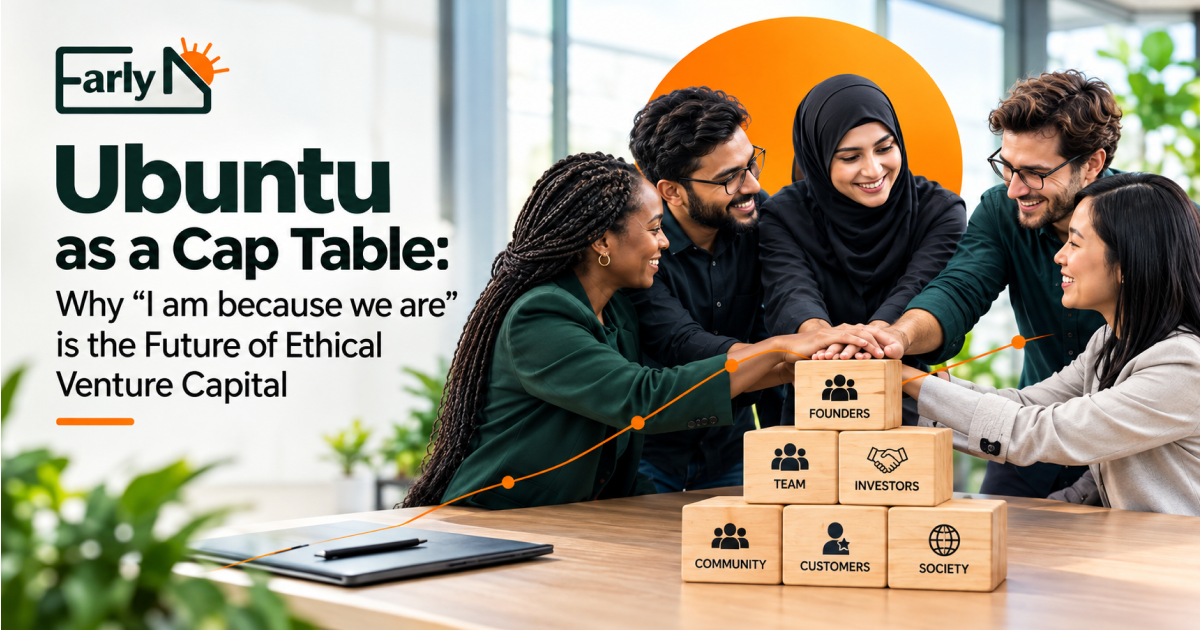
Ubuntu as a Cap Table: Why “I Am Because We Are” Is the Future of Ethical Venture Capital

Introduction: Rethinking Who Builds Wealth In traditional venture capital, success is often measured by valuation, equity percentages, investor returns, and exit opportunities.Founders pitch their ideas, investors provide capital, and ownership is divided according to financial contribution and perceived risk.But what if we looked at ownership differently?What if building a successful company was not simply about who invested the money, but also about who contributed the knowledge, effort, relationships, and communities that made the business possible?This is where the African philosophy of Ubuntu offers a powerful perspective.Often expressed as “I am because we are,” Ubuntu emphasizes our interconnectedness and the idea that individual well-being is closely linked to the well being of others.Applied to venture capital, Ubuntu invites us to rethink the cap table not merely as a record of who owns a company, but as a reflection of the broader network of people who help create its value.The question is no longer just how much wealth a company can generate, but who gets to participate in creating that wealth, and who benefits when it grows? What Is Ubuntu, and Why Does It Matter in Venture Capital? Ubuntu is a philosophical tradition associated with several communities across sub Saharan Africa. Although its interpretations vary, it commonly emphasizes human dignity, mutual responsibility, compassion, and community.In business, these principles challenge the assumption that success should be understood exclusively through individual achievement.A startup rarely succeeds because of its founder alone. Its progress depends on employees, customers, suppliers, advisors, investors, and communities. Each contributes something different, and not every contribution can be measured in money.Yet traditional venture capital tends to formalize financial contributions more directly than many other forms of value creation.Ubuntu encourages us to ask a different question: How can a company recognize interdependence while still rewarding risk, innovation, and investment fairly? The answer is not to eliminate financial returns or treat every contribution as identical. It is to build investment structures that consider fairness, transparency, long-term relationships, and shared prosperity alongside financial performance. The Traditional Cap Table: Who Owns the Value? A capitalization table, commonly called a cap table, records a company's ownership structure. It typically identifies founders, investors, employees with equity, and other shareholders, along with their respective ownership stakes.This information is essential. Investors need to understand their rights, founders need to manage dilution, and employees may need clarity about equity compensation.However, a cap table can also reveal the priorities embedded in a company's financing decisions.Consider a startup whose founders develop the original idea, whose employees turn it into a working product, and whose early customers provide feedback that shapes its direction. Investors supply the capital needed to accelerate growth.All these participants contribute to the company's success, but they participate in its financial upside in different ways.Employees may receive equity, but many do not. Customers may help improve a product without sharing in the value they help create. Communities may provide talent, infrastructure, and support without receiving any direct economic benefit.This does not mean that every stakeholder should automatically receive shares. Rather, it highlights an opportunity to design ownership and reward systems more thoughtfully.An Ubuntu inspired approach asks whether the distribution of value reflects the company's commitments to the people who help make its success possible. Turning Ubuntu Into an Ownership Philosophy Ubuntu does not prescribe a particular financial instrument or equity formula. Instead, it offers principles that founders and investors can translate into practical business decisions. 1. Recognize Contributions Beyond Capital Money is important, but it is not the only resource that helps a startup succeed. Employees contribute expertise and execution. Advisors provide experience. Customers contribute trust, feedback, and recurring revenue. Community partners may help a company understand local needs and reach underserved markets.Ethical venture capital can recognize these contributions through appropriate mechanisms, including employee equity plans, transparent incentive programs, profit-sharing arrangements, and long-term partnerships.The goal is not to assign an arbitrary monetary value to every act of support. It is to ensure that meaningful contributions are not overlooked when decisions about rewards are made. 2. Make Ownership Transparent Equity arrangements can be difficult to understand, especially for first-time founders and employees unfamiliar with venture financing.Unclear vesting conditions, unexpected dilution, complex share classes, and poorly explained agreements can create mistrust.An Ubuntu inspired approach prioritizes informed participation.Founders should explain ownership structures clearly, communicate the implications of financing decisions, and ensure that participants understand their rights and obligations before making commitments. Transparency does not eliminate difficult negotiations. It makes those negotiations more accountable and helps people make decisions with a clearer understanding of the consequences. 3. Balance Investor Returns With Long-Term Responsibility Venture capital involves risk. Investors commit resources to businesses that may fail, and they deserve a fair opportunity to earn returns.Ethical investing does not require ignoring that reality.Instead, it encourages investors and founders to consider how financial incentives influence decisions about employees, customers, suppliers, and the communities in which a business operates.For example, a company under pressure to achieve rapid growth might be tempted to cut essential employee support or pursue short-term revenue at the expense of customer trust.An Ubuntu-informed investment philosophy asks whether a growth strategy creates durable value or merely transfers costs to people with less power.Responsible ownership can support strong financial performance while maintaining attention to the wider consequences of business decisions. 4. Give Employees a Meaningful Stake in Success Employees often contribute directly to the innovation, execution, and problem-solving that increase a company's value.Equity compensation, employee ownership programs, and profit-sharing can help align their interests with the company's long-term performance. However, these arrangements should be designed carefully. Equity is not a substitute for fair wages, and ownership opportunities should come with clear explanations of vesting, dilution, liquidity, and risk.A meaningful stake involves more than distributing shares. It requires helping people understand what they own, what it could be worth, and what conditions affect its value. 5. Consider the Community Around the Business A company's impact extends beyond its shareholders.Its operations can influence local employment, access to technology, environmental conditions, and opportunities for other businesses.Founders and investors can reflect Ubuntu's principles by supporting local suppliers, investing in talent development, building accessible products, and creating partnerships that strengthen the communities connected to their work.These choices should be evaluated honestly rather than treated as branding exercises. Community benefit is most meaningful when it is connected to actual business practices and measurable outcomes. What an Ubuntu-Inspired Cap Table Could Look Like Imagine a growing technology startup that raises capital from an investor while building a product with a small team.A conventional financing discussion might focus primarily on the founder's ownership, the investor's stake, and the equity reserved for future employees.An Ubuntu-inspired discussion would still examine those numbers, but it would also ask additional questions: Do employees have a fair opportunity to participate in the company's long-term success? Are the founder's and investor's rights clearly understood? Have the people taking the greatest operational risks been considered in the incentive structure? Could profit-sharing or another reward mechanism create more balanced outcomes? How will the company remain accountable to its customers and community as it grows? The resulting structure might include founder equity, investor shares, an employee equity pool, and a separate profit-sharing arrangement. In some businesses, other mechanisms could be more appropriate.These are possibilities, not a universal formula. The right structure depends on the company's jurisdiction, stage, legal obligations, financing needs, and the contributions and risks of its stakeholders. The central idea is simple: design ownership intentionally rather than assuming that the default structure is automatically the fairest one. The Challenges of Ethical Venture Capital Applying Ubuntu to venture capital also raises difficult questions. Fairness Does Not Always Mean Equal Ownership An investor contributing significant capital assumes a different kind of risk from an employee contributing professional expertise. A founder may have spent years developing an idea before the company received funding.Treating every contribution as identical could ignore these differences.Fairness requires considering the nature of each contribution, the risks involved, the agreements made, and the expectations of the people participating. Shared Prosperity Requires Clear Governance Broader participation can make decision-making more complex.Companies must establish clear rules about voting rights, financial distributions, shareholder responsibilities, and the circumstances under which ownership can change.Ethical intentions cannot replace sound governance. In fact, clear governance is one of the ways those intentions become credible. Measuring Impact Is Difficult Financial returns are relatively straightforward to calculate. Social value, trust, employee well-being, and community resilience are more complicated.Companies can improve accountability by identifying specific objectives and measuring relevant indicators, such as employee retention, participation in equity plans, supplier diversity where appropriate, customer outcomes, and community investment.No single metric captures the full meaning of Ubuntu. Measurement should support judgment rather than reduce human relationships to a score. Why This Matters for the Future of Investing Entrepreneurs and investors increasingly face questions about how businesses create value, distribute opportunity, and respond to their wider responsibilities.An Ubuntu-inspired perspective can contribute to this conversation by challenging the idea that financial success and collective well-being must always compete.It encourages founders to build organizations where trust is treated as an asset, employees are recognized as contributors to value creation, and investors consider the long-term health of the businesses they support.It also offers a useful reminder for early-stage companies: the decisions made during fundraising can influence workplace culture, stakeholder relationships, and the distribution of future rewards for years.These decisions deserve attention before a company becomes successful not only after questions about fairness emerge.Ubuntu will not solve every challenge in venture capital, and it does not guarantee better investment returns. But it offers a valuable framework for asking better questions about the purpose and consequences of ownership. Conclusion: From Individual Success to Shared Prosperity A cap table is more than a spreadsheet. It is a record of financial ownership, negotiated rights, and expectations about future value.The philosophy of Ubuntu invites founders and investors to look beyond the numbers and consider the relationships behind them.Who helped create the opportunity? Who carries the risk? Who benefits from growth? And how can those benefits be distributed in ways that are transparent, responsible, and sustainable? These questions do not diminish the importance of entrepreneurship or investment.They help define what responsible entrepreneurship and investment can look like.The future of ethical venture capital may depend not only on how effectively investors identify promising companies, but also on how thoughtfully those companies recognize the people and communities that help them thrive. “I am because we are” is ultimately a reminder that value is created through relationships and that the way we share it matters. When ownership reflects that understanding, a cap table can become part of a broader commitment to building businesses that are not only financially successful, but also more inclusive, accountable, and resilient.The opportunity is not simply to fund the next successful company. It is to help build a future in which success creates meaningful value for more of the people who make it possible.

Read blog